
Jit compilation with Numba#
This is a rendered copy of advanced_numba.ipynb. You can optionally run it interactively on binder at this link
The purpose of this notebook is to teach you how to express operations that are hard to express in an array-oriented way in an imperative way and then jit compile them using numba and execute them as part of your coffea workflow.
It heavily builds on top of processing.ipynb, so please read that one first.
import hist
import hist.dask
import dask
import awkward as ak
import dask_awkward as dak
import matplotlib.pyplot as plt

from coffea import processor
from coffea.nanoevents import BaseSchema
from coffea.nanoevents.methods import candidate
from coffea.dataset_tools import (
    apply_to_fileset,
    preprocess,
)
from dask.distributed import Client

# here we connect to the cluster of our analysis facility.
# if you are on coffea-casa for example, that should be something like
# client = Client("tls://localhost:8786")
# locally we can make our own cluster though
from dask.distributed import LocalCluster

cluster = LocalCluster(threads_per_worker=1)
client = Client(cluster)

client
Client
Client-47ec0744-b51f-11f0-86ea-aae91076e0c2
| Connection method: Cluster object | Cluster type: distributed.LocalCluster |
| Dashboard: http://127.0.0.1:8787/status |
Cluster Info
LocalCluster
ecf6f5e1
| Dashboard: http://127.0.0.1:8787/status | Workers: 14 |
| Total threads: 14 | Total memory: 36.00 GiB |
| Status: running | Using processes: True |
Scheduler Info
Scheduler
Scheduler-b04ea2ee-97b1-4408-b5ad-4700b84bac46
| Comm: tcp://127.0.0.1:57032 | Workers: 14 |
| Dashboard: http://127.0.0.1:8787/status | Total threads: 14 |
| Started: Just now | Total memory: 36.00 GiB |
Workers
Worker: 0
| Comm: tcp://127.0.0.1:57063 | Total threads: 1 |
| Dashboard: http://127.0.0.1:57064/status | Memory: 2.57 GiB |
| Nanny: tcp://127.0.0.1:57035 | |
| Local directory: /var/folders/2c/94kt72fs0_q_9nzr2y5jphb00000gn/T/dask-scratch-space/worker-1glxwc5q | |
Worker: 1
| Comm: tcp://127.0.0.1:57066 | Total threads: 1 |
| Dashboard: http://127.0.0.1:57067/status | Memory: 2.57 GiB |
| Nanny: tcp://127.0.0.1:57037 | |
| Local directory: /var/folders/2c/94kt72fs0_q_9nzr2y5jphb00000gn/T/dask-scratch-space/worker-3adu2coh | |
Worker: 2
| Comm: tcp://127.0.0.1:57070 | Total threads: 1 |
| Dashboard: http://127.0.0.1:57072/status | Memory: 2.57 GiB |
| Nanny: tcp://127.0.0.1:57039 | |
| Local directory: /var/folders/2c/94kt72fs0_q_9nzr2y5jphb00000gn/T/dask-scratch-space/worker-cc4dq_yz | |
Worker: 3
| Comm: tcp://127.0.0.1:57068 | Total threads: 1 |
| Dashboard: http://127.0.0.1:57071/status | Memory: 2.57 GiB |
| Nanny: tcp://127.0.0.1:57041 | |
| Local directory: /var/folders/2c/94kt72fs0_q_9nzr2y5jphb00000gn/T/dask-scratch-space/worker-dmttm3bo | |
Worker: 4
| Comm: tcp://127.0.0.1:57075 | Total threads: 1 |
| Dashboard: http://127.0.0.1:57076/status | Memory: 2.57 GiB |
| Nanny: tcp://127.0.0.1:57043 | |
| Local directory: /var/folders/2c/94kt72fs0_q_9nzr2y5jphb00000gn/T/dask-scratch-space/worker-mqno2gaq | |
Worker: 5
| Comm: tcp://127.0.0.1:57077 | Total threads: 1 |
| Dashboard: http://127.0.0.1:57079/status | Memory: 2.57 GiB |
| Nanny: tcp://127.0.0.1:57045 | |
| Local directory: /var/folders/2c/94kt72fs0_q_9nzr2y5jphb00000gn/T/dask-scratch-space/worker-9uyl5xyj | |
Worker: 6
| Comm: tcp://127.0.0.1:57091 | Total threads: 1 |
| Dashboard: http://127.0.0.1:57094/status | Memory: 2.57 GiB |
| Nanny: tcp://127.0.0.1:57047 | |
| Local directory: /var/folders/2c/94kt72fs0_q_9nzr2y5jphb00000gn/T/dask-scratch-space/worker-u3n0o6e1 | |
Worker: 7
| Comm: tcp://127.0.0.1:57081 | Total threads: 1 |
| Dashboard: http://127.0.0.1:57082/status | Memory: 2.57 GiB |
| Nanny: tcp://127.0.0.1:57049 | |
| Local directory: /var/folders/2c/94kt72fs0_q_9nzr2y5jphb00000gn/T/dask-scratch-space/worker-tx7pd3yd | |
Worker: 8
| Comm: tcp://127.0.0.1:57096 | Total threads: 1 |
| Dashboard: http://127.0.0.1:57097/status | Memory: 2.57 GiB |
| Nanny: tcp://127.0.0.1:57051 | |
| Local directory: /var/folders/2c/94kt72fs0_q_9nzr2y5jphb00000gn/T/dask-scratch-space/worker-4jnv37qp | |
Worker: 9
| Comm: tcp://127.0.0.1:57090 | Total threads: 1 |
| Dashboard: http://127.0.0.1:57092/status | Memory: 2.57 GiB |
| Nanny: tcp://127.0.0.1:57053 | |
| Local directory: /var/folders/2c/94kt72fs0_q_9nzr2y5jphb00000gn/T/dask-scratch-space/worker-s13l9u93 | |
Worker: 10
| Comm: tcp://127.0.0.1:57084 | Total threads: 1 |
| Dashboard: http://127.0.0.1:57085/status | Memory: 2.57 GiB |
| Nanny: tcp://127.0.0.1:57055 | |
| Local directory: /var/folders/2c/94kt72fs0_q_9nzr2y5jphb00000gn/T/dask-scratch-space/worker-_zbxjn79 | |
Worker: 11
| Comm: tcp://127.0.0.1:57087 | Total threads: 1 |
| Dashboard: http://127.0.0.1:57088/status | Memory: 2.57 GiB |
| Nanny: tcp://127.0.0.1:57057 | |
| Local directory: /var/folders/2c/94kt72fs0_q_9nzr2y5jphb00000gn/T/dask-scratch-space/worker-7_23ysbh | |
Worker: 12
| Comm: tcp://127.0.0.1:57100 | Total threads: 1 |
| Dashboard: http://127.0.0.1:57103/status | Memory: 2.57 GiB |
| Nanny: tcp://127.0.0.1:57059 | |
| Local directory: /var/folders/2c/94kt72fs0_q_9nzr2y5jphb00000gn/T/dask-scratch-space/worker-7h0pdt_z | |
Worker: 13
| Comm: tcp://127.0.0.1:57099 | Total threads: 1 |
| Dashboard: http://127.0.0.1:57101/status | Memory: 2.57 GiB |
| Nanny: tcp://127.0.0.1:57061 | |
| Local directory: /var/folders/2c/94kt72fs0_q_9nzr2y5jphb00000gn/T/dask-scratch-space/worker-82h1qbl6 | |
BokehUserWarning: reference already known 'p1011'
BokehUserWarning: reference already known 'p1051'
BokehUserWarning: reference already known 'p1289'
BokehUserWarning: reference already known 'p1295'
BokehUserWarning: reference already known 'p1361'
fileset = {
    "DoubleMuon": {
        "files": {
            "/Users/iason/work/pyhep_dev/uscms-idap-training/coffea/Run2012B_DoubleMuParked.root": "Events",
            # "root://eospublic.cern.ch//eos/root-eos/cms_opendata_2012_nanoaod/Run2012B_DoubleMuParked.root": "Events",
            "/Users/iason/work/pyhep_dev/uscms-idap-training/coffea/Run2012C_DoubleMuParked.root": "Events",
            # "root://eospublic.cern.ch//eos/root-eos/cms_opendata_2012_nanoaod/Run2012C_DoubleMuParked.root": "Events",
        },
        "metadata": {
            "is_mc": False,
        },
    },
    "ZZ to 4mu": {
        "files": {
            "/Users/iason/work/pyhep_dev/uscms-idap-training/coffea/ZZTo4mu.root": "Events",
            # "root://eospublic.cern.ch//eos/root-eos/cms_opendata_2012_nanoaod/ZZTo4mu.root": "Events",
        },
        "metadata": {
            "is_mc": True,
        },
    },
}

dataset_runnable, dataset_updated = preprocess(
    fileset,
    align_clusters=False,
    step_size=100_000,
    files_per_batch=1,
    skip_bad_files=True,
    save_form=False,
)
Getting fancy#
Let’s flesh out the processor from the procesing.ipynb notebook into a 4-muon analysis, searching for diboson events:
import numba


@numba.njit
def find_4lep_kernel(events_leptons, builder):
    """Search for valid 4-lepton combinations from an array of events * leptons {charge, ...}

    A valid candidate has two pairs of leptons that each have balanced charge
    Outputs an array of events * candidates {indices 0..3} corresponding to all valid
    permutations of all valid combinations of unique leptons in each event
    (omitting permutations of the pairs)
    """
    for leptons in events_leptons:
        builder.begin_list()
        nlep = len(leptons)
        for i0 in range(nlep):
            for i1 in range(i0 + 1, nlep):
                if leptons[i0].charge + leptons[i1].charge != 0:
                    continue
                for i2 in range(nlep):
                    for i3 in range(i2 + 1, nlep):
                        if len({i0, i1, i2, i3}) < 4:
                            continue
                        if leptons[i2].charge + leptons[i3].charge != 0:
                            continue
                        builder.begin_tuple(4)
                        builder.index(0).integer(i0)
                        builder.index(1).integer(i1)
                        builder.index(2).integer(i2)
                        builder.index(3).integer(i3)
                        builder.end_tuple()
        builder.end_list()

    return builder


def find_4lep(events_leptons):
    if ak.backend(events_leptons) == "typetracer":
        # here we fake the output of find_4lep_kernel since
        # operating on length-zero data returns the wrong layout!
        ak.typetracer.touch_data(events_leptons.charge)  # force touching of the necessary data
        return ak.Array(ak.Array([[(0, 0, 0, 0)]]).layout.to_typetracer(forget_length=True))
    return find_4lep_kernel(events_leptons, ak.ArrayBuilder()).snapshot()


class FancyDimuonProcessor(processor.ProcessorABC):
    def __init__(self, mode="virtual"):
        assert mode in ["eager", "virtual", "dask"]
        self._mode = mode

    def process(self, events):
        dataset_axis = hist.axis.StrCategory([], growth=True, name="dataset", label="Primary dataset")
        mass_axis = hist.axis.Regular(300, 0, 300, name="mass", label=r"$m_{\mu\mu}$ [GeV]")
        pt_axis = hist.axis.Regular(300, 0, 300, name="pt", label=r"$p_{T,\mu}$ [GeV]")

        if self._mode == "dask":
            hist_class = hist.dask.Hist
        else:
            hist_class = hist.Hist

        h_nMuons = hist_class(
            dataset_axis,
            hist.axis.IntCategory(range(6), name="nMuons", label="Number of good muons"),
            storage="weight",
            label="Counts",
        )
        h_m4mu = hist_class(dataset_axis, mass_axis, storage="weight", label="Counts")
        h_mZ1 = hist_class(dataset_axis, mass_axis, storage="weight", label="Counts")
        h_mZ2 = hist_class(dataset_axis, mass_axis, storage="weight", label="Counts")
        h_ptZ1mu1 = hist_class(dataset_axis, pt_axis, storage="weight", label="Counts")
        h_ptZ1mu2 = hist_class(dataset_axis, pt_axis, storage="weight", label="Counts")

        cutflow = dict()

        dataset = events.metadata["dataset"]
        muons = ak.zip(
            {
                "pt": events.Muon_pt,
                "eta": events.Muon_eta,
                "phi": events.Muon_phi,
                "mass": events.Muon_mass,
                "charge": events.Muon_charge,
                "isolation": events.Muon_pfRelIso03_all,
            },
            with_name="PtEtaPhiMCandidate",
            behavior=candidate.behavior,
        )

        # make sure they are sorted by transverse momentum
        muons = muons[ak.argsort(muons.pt, axis=1)]

        cutflow["all events"] = ak.num(muons, axis=0)

        # impose some quality and minimum pt cuts on the muons
        muons = muons[(muons.pt > 5) & (muons.isolation < 0.2)]
        cutflow["at least 4 good muons"] = ak.sum(ak.num(muons) >= 4)
        h_nMuons.fill(dataset=dataset, nMuons=ak.num(muons))

        # reduce first axis: skip events without enough muons
        muons = muons[ak.num(muons) >= 4]

        # find all candidates with helper function
        if self._mode == "dask":
            fourmuon = dak.map_partitions(find_4lep, muons)
        else:
            fourmuon = find_4lep_kernel(ak.materialize(muons), ak.ArrayBuilder()).snapshot()
        fourmuon = [muons[fourmuon[idx]] for idx in "0123"]

        fourmuon = ak.zip(
            {
                "z1": ak.zip(
                    {
                        "lep1": fourmuon[0],
                        "lep2": fourmuon[1],
                        "p4": fourmuon[0] + fourmuon[1],
                    }
                ),
                "z2": ak.zip(
                    {
                        "lep1": fourmuon[2],
                        "lep2": fourmuon[3],
                        "p4": fourmuon[2] + fourmuon[3],
                    }
                ),
            }
        )

        cutflow["at least one candidate"] = ak.sum(ak.num(fourmuon) > 0)

        # require minimum dimuon mass
        fourmuon = fourmuon[(fourmuon.z1.p4.mass > 60.0) & (fourmuon.z2.p4.mass > 20.0)]
        cutflow["minimum dimuon mass"] = ak.sum(ak.num(fourmuon) > 0)

        # choose permutation with z1 mass closest to nominal Z boson mass
        bestz1 = ak.singletons(ak.argmin(abs(fourmuon.z1.p4.mass - 91.1876), axis=1))
        fourmuon = ak.flatten(fourmuon[bestz1])

        h_m4mu.fill(
            dataset=dataset,
            mass=(fourmuon.z1.p4 + fourmuon.z2.p4).mass,
        )
        h_mZ1.fill(
            dataset=dataset,
            mass=fourmuon.z1.p4.mass,
        )
        h_mZ2.fill(
            dataset=dataset,
            mass=fourmuon.z2.p4.mass,
        )
        h_ptZ1mu1.fill(
            dataset=dataset,
            pt=fourmuon.z1.lep1.pt,
        )
        h_ptZ1mu2.fill(
            dataset=dataset,
            pt=fourmuon.z1.lep2.pt,
        )
        return {
            "nMuons": h_nMuons,
            "mass": h_m4mu,
            "mass_z1": h_mZ1,
            "mass_z2": h_mZ2,
            "pt_z1_mu1": h_ptZ1mu1,
            "pt_z1_mu2": h_ptZ1mu2,
            "cutflow": {dataset: cutflow},
        }

    def postprocess(self, accumulator):
        pass
import time

tstart = time.time()

run = processor.Runner(
    executor=processor.DaskExecutor(client=client, compression=None),
    schema=BaseSchema,
    chunksize=100_000,
)

out = run(
    fileset,
    processor_instance=FancyDimuonProcessor("virtual"),
)

elapsed = time.time() - tstart
elapsed
Processing 100% ━━━━━━━━━━━━━━━━━━━━━━━━━━━━━━━━━━━━━━━━━━━━━━━━━━━━━━ 701/701 [ 0:00:10 < 0:00:00 | 65.4 chunk/s ]
11.421343088150024
nevt = out["cutflow"]["ZZ to 4mu"]["all events"] + out["cutflow"]["DoubleMuon"]["all events"]
print("Events/s:", nevt / elapsed)
Events/s: 5801716.61849036
What follows is just us looking at the output, you can execute it if you wish
# scale ZZ simulation to expected yield
lumi = 11.6  # 1/fb
zzxs = 7200 * 0.0336**2  # approximate 8 TeV ZZ(4mu)
nzz = out["cutflow"]["ZZ to 4mu"]["all events"]

scaled = {}
for name, h in out.items():
    if isinstance(h, hist.Hist):
        scaled[name] = h.copy()
        scaled[name].view()[1, :] *= lumi * zzxs / nzz
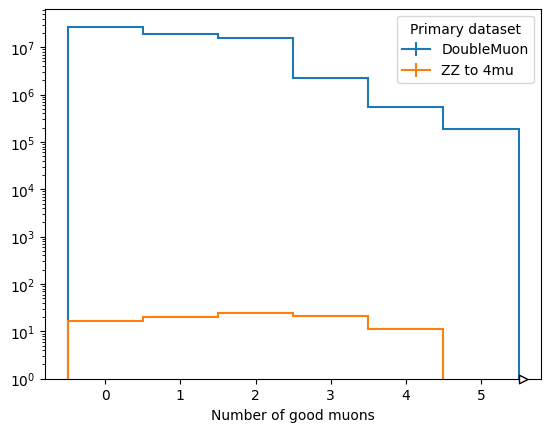
fig, ax = plt.subplots()

scaled["nMuons"].plot1d(ax=ax, overlay="dataset")
ax.set_yscale("log")
ax.set_ylim(1, None)
plt.show()
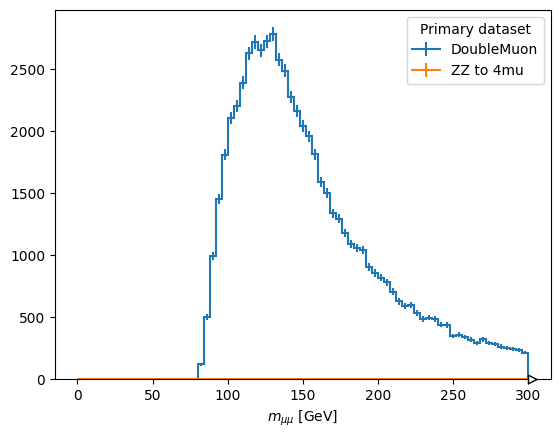
fig, ax = plt.subplots()

scaled["mass"][:, :: hist.rebin(4)].plot1d(ax=ax, overlay="dataset")
plt.show()
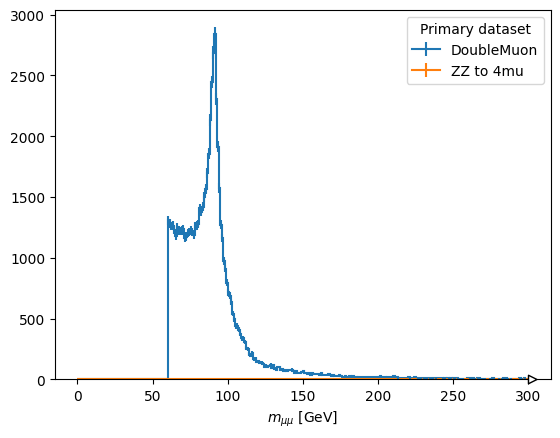
fig, ax = plt.subplots()

scaled["mass_z1"].plot1d(ax=ax, overlay="dataset")
plt.show()
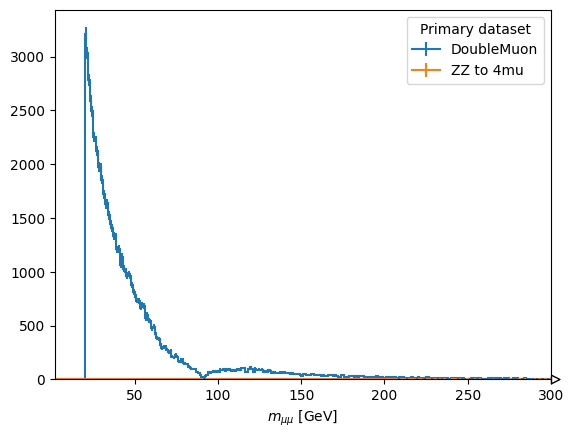
fig, ax = plt.subplots()

scaled["mass_z2"].plot1d(ax=ax, overlay="dataset")
ax.set_xlim(2, 300)
plt.show()
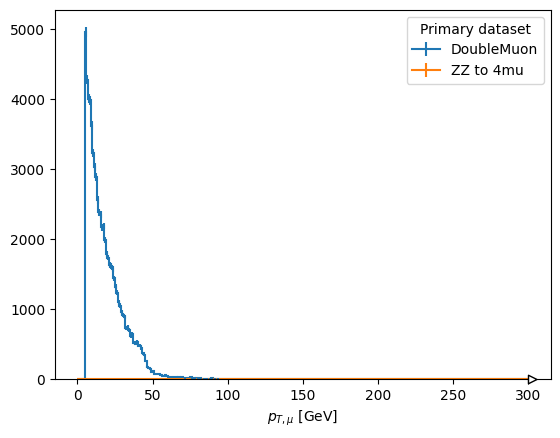
fig, ax = plt.subplots()

scaled["pt_z1_mu1"].plot1d(ax=ax, overlay="dataset")
plt.show()
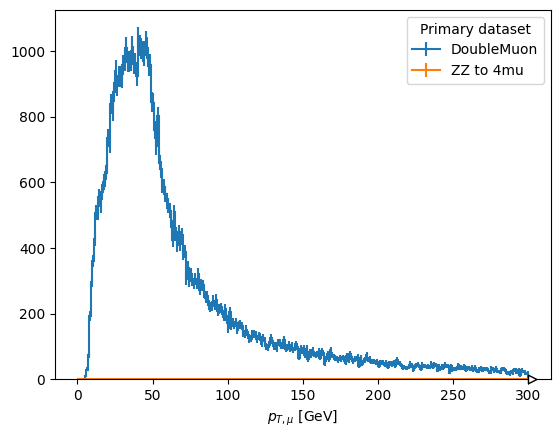
fig, ax = plt.subplots()

scaled["pt_z1_mu2"].plot1d(ax=ax, overlay="dataset")
plt.show()
import time

tstart = time.time()

to_compute = apply_to_fileset(
    FancyDimuonProcessor("dask"),
    dataset_runnable,
    schemaclass=BaseSchema,
)
(out,) = dask.compute(to_compute)

elapsed = time.time() - tstart
elapsed
29.73838996887207
nevt = out["ZZ to 4mu"]["cutflow"]["ZZ to 4mu"]["all events"] + out["DoubleMuon"]["cutflow"]["DoubleMuon"]["all events"]
print("Events/s:", (nevt / elapsed))
Events/s: 2228210.6082191938
What follows is just us looking at the output, you can execute it if you wish
# scale ZZ simulation to expected yield
lumi = 11.6  # 1/fb
zzxs = 7200 * 0.0336**2  # approximate 8 TeV ZZ(4mu)
nzz = out["ZZ to 4mu"]["cutflow"]["ZZ to 4mu"]["all events"]

scaled = {}
for (name1, h1), (nam2, h2) in zip(out["DoubleMuon"].items(), out["ZZ to 4mu"].items()):
    if isinstance(h1, hist.Hist) and isinstance(h2, hist.Hist):
        scaled[name1] = h1.copy() + h2.copy()
        scaled[name1].view()[1, :] *= lumi * zzxs / nzz
fig, ax = plt.subplots()

scaled["nMuons"].plot1d(ax=ax, overlay="dataset")
ax.set_yscale("log")
ax.set_ylim(1, None)
plt.show()
fig, ax = plt.subplots()

scaled["mass"][:, :: hist.rebin(4)].plot1d(ax=ax, overlay="dataset")
plt.show()
fig, ax = plt.subplots()

scaled["mass_z1"].plot1d(ax=ax, overlay="dataset")
plt.show()
fig, ax = plt.subplots()

scaled["mass_z2"].plot1d(ax=ax, overlay="dataset")
ax.set_xlim(2, 300)
plt.show()
fig, ax = plt.subplots()

scaled["pt_z1_mu1"].plot1d(ax=ax, overlay="dataset")
plt.show()
fig, ax = plt.subplots()

scaled["pt_z1_mu2"].plot1d(ax=ax, overlay="dataset")
plt.show()